
Early Tithonian ammonites, microfacies, biostratigraphy, and biogeography from the Mészkemence section (Zengővárkony, Mecsek Mountains, South Hungary)
Article Sidebar
Main Article Content
Abstract
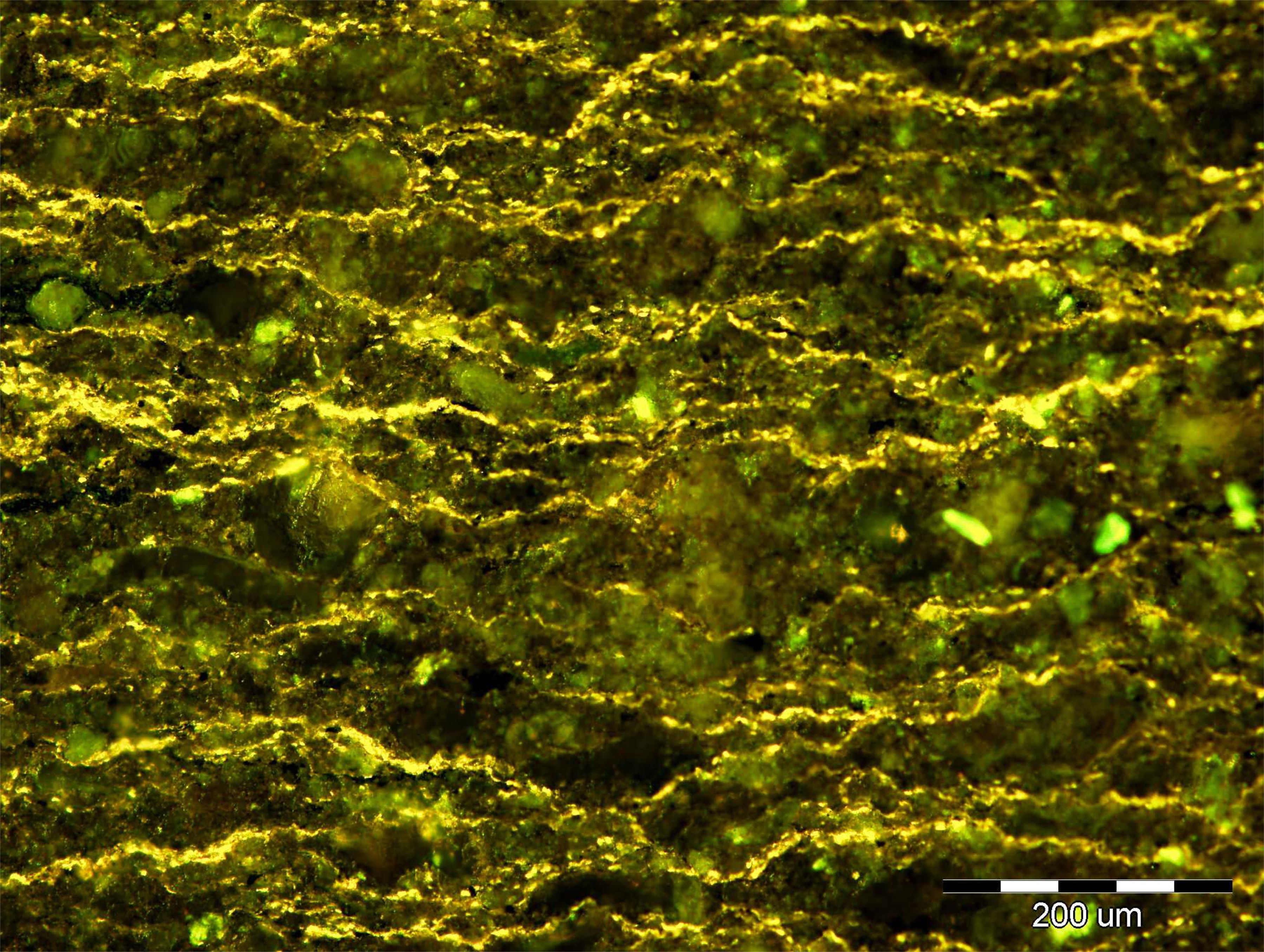
A rich but poorly preserved Lower Tithonian faunal assemblage is reported from the abandoned limekilns at Zengővárkony (Mecsek Mountains, Hungary). Except the Darwini Zone, all Lower Tithonian ammonite chronozones (Hybonotum, Semiforme, Fallauxi, and Peroni/Ponti) zones are recognised Fallauxi and Ponti/Peroni zones are first recorded from the region. The pelagic fauna is dominated by ammonites and their aptychi. Brachiopods, belemnites, and very rarely bivalves are accessory elements of the fauna. The mollusc fauna comprises 167 specimens that represent 18 genera and 13 species. Volanoceras sp. ex gr. volanense, Pseudopallasiceras? sp., Biplisphinctes pseudocolubrinus, Aulacosphinctoides sp. ex gr. infundibulum, and Physodoceras cf. widerai are first records from the Mecsek Mountains. The ammonite fauna has typical Mediterranean character. Based on cluster analysis, the fauna is closest to the ammonite assemblages of the Transdanubian Range (Hungary).
Article Details
Issue
Section

This work is licensed under a Creative Commons Attribution 4.0 International License.
Authors have copyright and publishing rights on all published manuscripts.
References
ARENILLAS, I., ARZ, J.A. & GILABERT, V. (2022): An updated suprageneric classification of planktic foraminifera after growing evidence of multiple benthic-planktic transitions.– Spanish Journal of Palaeontology, 37/1, 1–34. http://doi.org/10.7203/sjp.22189
ARKELL, W.J. (1950): A classification of the Jurassic ammonites.– Journal of Paleontology, 24, 354–364.
BÁLDI-BEKE, M. (1965): The genus Nannoconus (Protozoa, inc. sedis) in Hungary.– Geologica Hungarica series Palaeontologica, 30, 107–148.
BARTHEL, K.W. (1962): Zur Ammonitenfauna und Stratigraphie der Neuburger Bankkalke.– Bayerische Akademie der Wissenschaften Mathematisch-Naturwissenschaftliche Klasse Abhandlungen, Neue Folge, 105, 1–30.
BENZAGGAGH, M. (2000): Le malm supérier et le Berriasien dans le Prérif Interne et le Mésorif (Rif, Maroc): biostratigraphie, lithostratigraphie, paléogéographie et évolution tectono-sédimentaire.– Documents Laboratoire Géologique Lyon, 152, 1–347.
BENZAGGAGH, M. & ATROPS, F. (1997): Stratigraphie et association de faune d’ammonites des zones du Kimméridgien, Tithonien et Berriasien basal dans le Prérif interne (Rif, Maroc).– Newsletters on Stratigraphy, 35/3, 127–163.
BENZAGGAGH, M., CECCA, F. & ROUGET, I. (2010): Biostratigraphic distribution of ammonites and calpionellids in the Tithonian of the internal Prerif (Msila area, Morocco).– Paläontologische Zeitschrift, 84, 301–315. https://doi.org/10.1007/s12542-009-0045-1
BEURLEN, K. (1944): Beiträge zur Stammesgeschichte der Muscheln.‒ Sitzungsberichte der Mathematisch-naturwissenschaftliche Abtheilung der Bayerischen Akademie der Wissenschaften München, 1–2, 133–145.
BOUGHDIRI, M., OLÓRIZ, F., MARQUES, B.L., LAYEB, M., DE MATOS, J. & SALLOUHI, H. (2005): Upper Kimmeridgian and Tithonian ammonites from the Tunisian «Dorsale» (NE Tunisia): updated biostratigraphy from the Jebel Oust.– Rivista Italiana di Paleontologia e Stratigrafia, 111/2, 305–316. https://doi.org/10.13130/2039-4942/6320
BÖCKH, J. (1880): Adatok a Mecsekhegység és dombvidéke jurakorbeli lerakodásainak ismeretéhez. I. Stratigraphiai rész. Értekezések a természettudományok köréből, 10/10, 1–50.
BREISTROFFER, M. (1947): Notes de Nomenclature paléozoologique.– Procès-verbal Mensuel de la Société Scientifique du Dauphiné (26th year), 195, 99–103.
BUCKMAN, S.S. (1921): Type Ammonites: Vol. 3.‒ Wheldon & Wesley. London, 266 p.
BUJTOR, L. (1993): Valanginian ammonite fauna from the Kisújbánya Basin (Mecsek Mts., South Hungary) and its palaeobiogeographical significance.– Neues Jahrbuch für Geologie und Paläontologie, Abhandlungen, 188/1, 103–131. https://doi.org/10.1127/njgpa/188/1993/103
BUJTOR, L. (2025): Lower Kimmeridgian ammonite-based biochronostratigraphy, biogeography, and microfacies of the Mecsek Mountains (South Hungary).– Bollettino della Società Paleontologica Italiana, 64/2, 435–457. https://doi.org/10.4435/BSPI.2025
BUJTOR, L., ALBRECHT, R., FARKAS, CS., MAKÓ, B., MARÓTI, D. & MIKLÓSY, Á. (2021a): Kimmeridgian and early Tithonian cephalopods from the Kisújbánya Limestone Formation, Zengővárkony (Mecsek Mountains, southern Hungary), their faunal composition, palaeobiogeographic affinities, and taphonomic character.– Carnets de Géologie, 21/13, 265–314. https://doi.org/10.2110/carnets.2021.2113
BUJTOR, L. ALBRECHT, R., MARÓTI, D. & MIKLÓSY, Á. (2021b): Lower Tithonian and lower Berriasian brachiopods from the Márévár Limestone Formation, Zengővárkony (Mecsek Mountains Hungary), and remarks on their palaeoenvironment.– PalZ, 95, 85– 95. http://doi.org/10.1007/s12542-020-00513-y
BURCKHARDT, C. (1903): Beiträge zur Kentniss der Jura und Kreideformation der Cordillere.– Palaeontographica, 50/1–3, 1–144.
CECCA, F. (1990a): “Subplanitoides” mediterraneus, nuova specie di Perisphinctide (Ammonitina) della Zona a Semiforme (Titonico inferiore) della provincia mediterranea.‒ In: PALLINI, G., CECCA, F., CRESTA, S. & SANTANTONIO, M. (eds.): Atti II Convegno Internazionale Fossili, Evoluzione, Ambiente. Pergola 1987, 57–62.
CECCA, F. (1990b): Etude des Périsphinctidés de la zone à Darwini (Tithonique inférieur) des Apennins des Marches (Italie): paléontologie et paléobiogéographie. In: PALLINI, G., CECCA, F., CRESTA, S. & SANTANTONIO, M. (eds.) Atti II Convegno Internazionale Fossili, Evoluzione, Ambiente, Pergola 1987, 39–55.
CECCA, F. (1999): Palaeobiogeography of Tethyan ammonites during the Tithonian (latest Jurassic).– Palaeogeography, Palaeoclimatology, Palaeoecology, 147, 1–37. http://doi.org/10.1016/S0031-0182(98)00149-7
CECCA, F. & ÉNAY, R. (1991): Les ammonites des zones à Semiforme et à Fallauxi du Tithonique de l’Ardèche (sud-est de la France): Stratigraphie, paleontologie, paleobiogeographie.– Palaeontographica Abt. A, 219/1–3, 1–87.
CECCA, F. & SANTANTONIO, M. (1989): Kimmeridgian and Lower Tithonian ammonite assemblages in the Umbria – Marches – Sabine Apennines (Central Italy).– In: ROCHA, R.B. & SOARES, A.F. (eds): 2nd International Symposium on Jurassic Stratigraphy, 1988. Lisboa, 525–542.
CECCA, F., CRESTA, S. & SANTANTONIO, M. (1983): Ammoniti del Malm dell’Appennino Marchigiano conservate nel Museo del Servizio geologico d’Italia.– Bollettino del Servizio Geologico d’Italia, 102, 109–132.
CECCA, F., CRESTA, S., PALLINI, G. & SANTANTONIO, M. (1985): Remarks on the Kimmeridgian–Lower Tithonian ammonite biostratigraphy of two sections in the Central Apennines (Italy).– Newsletters on Stratigraphy, 15/1, 28–36.
CECCA, F., CRESTA, S., PALLINI, G. & SANTANTONIO, M. (1986): Biostratigrafia ed ammoniti del Dogger – Malm di Colle Tordina (Monti della Rossa, Appennino Marchigiano).– Bollettino del Servizio Geologico d’Italia, 104, 177–204.
CECCA, F., ÉNAY, R. & LE HEGARAT, G. (1989): L’Ardescien (Tithonique supérieur) de la région stratotypique: séries de référence et faunes (ammonites, calpionelles) de la bordure ardéchoise.– Documents des Laboratoires de Géologie, Lyon, 107, 1–115.
CHECA, A.G. (1985): Los Aspidoceratiformes en Europa (Ammonitina, Fam. Aspidoceratidae: subfamilias Aspidoceratinae y Physodoceratinae).– Unpublished PhD Thesis, Universidad de Granada, Spain, 413 p.
COHEN, K.M., FINNEY, S.C., GIBBARD, P.L. & FAN., J.-X. (2013): The ICS International Chronostratigraphic Chart.– Episodes, 36, 199–204.
COX, L.R., NEWELL, N.D., BRANSON, C.C., CASEY, R., CHAVAN, A., COOGAN, A.H., DECHASEAUX, C., FLEMING, C.A., HAAS, F., HERTLEIN, L.G., KEEN, A.M., LAROCQUE, A., MCALESTER, A.L., PERKINS, B.F., PURI, H.S., SMITH, L.A., SOOT-RYEN, T., STENZEL, H.B., TURNER, R.D. & WEIR, J. (1969): Systematic descriptions. p. N225–N907.‒ In: COX, L.R., NEWELL, N.D., BOYD, D.W., BRANSON, C.C., CASEY, R., CHAVAN, A., COOGAN, A.H., DECHASEAUX, C., FLEMING, C.A., HAAS, F., HERTLEIN, L.G., KAUFFMAN, E.G., KEEN, A.M., LAROCQUE, A., MCALESTER, A.L., MOORE, R.C., NUTTALL, C.P., PERKINS, B.F., PURI, H.S., SMITH, L.A., SOOT-RYAN, T., STENZEL, H.B., TRUEMAN, E.R., TURNER, R.D. & WEIR, J. (eds.): Treatise on invertebrate paleontology: Part N, Volume 1: Mollusca 6, Bivalvia.– The University of Kansas and The Geological Society of America, Lawrence, 951 p.
CSONTOS, L. & VÖRÖS, A. (2004): Mesozoic plate tectonic reconstruction of the Carpathian region.– Palaeogeography, Palaeoclimatology, Palaeoecology, 210, 1–56. https://doi.org/10.1016/j.palaeo.2004.02.033
CSONTOS, L., BENKOVICS, L., BERGERAT, F., MANSY, J.-L. & WÓRUM, G. (2002): Tertiary deformation history from seismic section study and fault analysis in a former European Tethyan margin (the Mecsek–Villány area, SW Hungary).– Tectonophysics, 357, 81–102.
CUVIER, G. (1797): Tableau élémentaire de l’Histoire naturelle des animaux.– Imprimeur Baudouin, Paris, 302 p.
DEL CAMPANA, D. (1905): Fossili del Giura superiore dei Sette Comuni in Provincia di Vicenza.– Pubblicazione del Reale Istituto di Studi superiori sezione Scienze Fisiche e Naturali, 28, 3–140.
DOUVILLÉ, H. (1890): Sur la classification des Cératites de la Craie.– Bulletin de la Société Géologique de France (3e série), 18, 275–292.
D’ORBIGNY, A. (1841): Paléontologie française. Description zoologique et géologique de tous les animaux m ollusques et rayonnes fossiles de France.– In: Terrains crétacés. I. Céphalopodes.– Masson, Paris, 430 p; 1–120 [1840], 121–430 [1841].
EICHWALD, E. (1861): Der Grünsand in der Umgegend von Moskwa.– Bulletin de la Société impériale des naturalistes de Moscou, 34, 278–313.
ÉNAY, R. & HOWARTH, M.K. (2019): Treatise Online no. 120: Part L, Volume 3B, Chapter 7: Systematic descriptions of the Perisphinctoidea.– Treatise Online, 115-127, 1–184. https://doi.org/10.17161/to.v0i0.11672
ÉNAY, R., HANTZPERGUE, P., SOUSSI, M. & MANGOLD, C. (2005): La limite Kimméridgien-Tithonien et l’âge des formations du Jurassique supérieur de la Dorsale tunisienne, comparaisons avec l’Algérie et Sicily.– Géobios, 38, 437–450.
FAVRE, E. (1879): Descrption des fossiles des couches tithoniques des Alpes fribourgeoises.– Mémoires de la Société Paléontologique Suisse, 6, 5–74.
FISCHER, P. (1882): Manuel de Conchyliologie et de Paléontologie conchyliologique.– Librairie F. Savy, Paris, 1369 p.
FONTANNES, F. (1879): Description des ammonites des calcaires du Chateau de Crussol – Ardèche – (Zones à Oppelia tenuilobata et Waagenia beckeri).– Librairie Georg, Lyon, 122 p.
FŐZY, I. (1989): Upper Jurassic ammonite biostratigraphy in the Bakony Mts. (Hungary).– Földtani Közlöny, 119/2, 133–151.
FŐZY, I. (1990): Ammonite succession from three Upper Jurassic sections in the Bakony Mts. (Hungary).– In: PALLINI, G., CECCA, F., CRESTA, S. & SANTANTONIO, M. (eds.): Fossili, Evoluzione, Ambiente.– Atti II Convegno Internationale Fossili, Evoluzione, Ambiente. Pergola, 323–329.
FŐZY, I. (1993): Upper Jurassic ammonite biostratigraphy of the Mecsek Mts, southern Hungary.– Földtani Közlöny, 123/2, 195–205.
FŐZY, I. (2012): Magyarország litosztratigráfiai alapegységei Jura.– Magyarhoni Földtani Társulat, Budapest, 235 p.
FŐZY, I. & SCHERZINGER, A. (2013): Systematic descriptions of Tithonian ammonites of the Gerecse Mountains– In: FŐZY, I. (ed.): Late Jurassic–Early Cretaceous Fauna, Biostratigraphy, Facies and Deformation History of the Carbonate Formations in the Gerecse and Pilis Mountains (Transdanubian Range, Hungary). GeoLitera Publishing House, Szeged, 207–292.
FŐZY, I., KÁZMÉR, M. & SZENTE, I. (1994): A unique Lower Tithonian fauna in the Gerecse Mts, Hungary.– Palaeopelagos Special Publications, 1, 155–165.
FŐZY, I., SCHERZINGER, A. & SZIVES, O. (2022): Late Jurassic–Early Cretaceous (Kimmeridgian–Barremian) ammonites of the Bakony Mountains (Transdanubian Range, Hungary).– In: FŐZY, I. (ed.): Fauna, biostratigraphy, facies and paleotectonic evolution of the Late Jurassic–Early Cretaceous formations in the Bakony Mountains (Transdanubian Range, Hungary). Institute of Geosciences, University of Szeged, GeoLitera Publishing House, 243–360.
FÜLÖP, J. (1967): A júra–kréta határ kérdéséről.– Magyar Állami Földtani Intézet, Budapest, 28 p.
GALÁCZ, A. (1984): Jurassic of Hungary: a review.– Acta Geologica Hungarica, 37/3–4, 359– 377.
GALLOIS, R.W. & ETCHES, S.M. (2010): The distribution of the ammonite Gravesia (Salfeld, 1913) in the Kimmeridge Clay Formation (late Jurassic) in Britain.– Geoscience in South-West England, 12, 240–249.
GEMMELLARO, G. (1871): Sopra alcuni cefalopodi del Titonio inferiore di Sicilia.– Atti dell’Accademia Gioenia di Scienze Naturali di Catania, serie Terza, 5, 53–67.
GIEBEL, C.G.A. (1852): Allgemeine Palaeontologie: Entwurf einer Systematischen Darstellung der Fauna und Flora der Vorwelt, zum Gebrauche bei Vorlesungen und zum Selbstunterrichte.– Ambrosius Abel, Leipzig. [I–V] + VI–VIII; Paläontologie, Allgemeine Bestimmungen. p. 1–12, I. Erster Theil, Paläozoologie, p. [13–15] + 16– 328; II. Zweiter Theil, p. [329–331] + 332–398; Register, p. [399] + 400–413; Druckfehler, 414 p.
GRIGORE, D. (2011): Kimmeridgian – Lower Tithonian ammonite assemblages from Ghilcos – Haghimas Massif (Eastern Carpathians, Romania).– Acta Palaeontologica Romaniae, 7, 177–189.
GRIGORE, D. (2013): Revised ammonites fauna (Phylloceratids, Lytoceratids and Aspidoceratids-Sutneria species) from „Acanthicum beds” of the Hăghimaş Mts. (Eastern Carpathians – Romania).– Revue Roumaine de Géologie, 57/1–2, 81–110.
GRIGORE, D. (2023): Aspidoceras and Pseudowaagenia species (Aspidoceratidae, Ammonoidea) from the Upper Jurassic of the Hăghimaş Mts. (Eastern Carpathians – Romania).– Oltenia. Studii şi comunicări. Ştiinţele Naturii, 39/2, 16–27.
GRIGORE, D. (2025): Aspidoceratidae (Epaspidoceras, Schaireria, Hybonoticeras) species from the Upper Jurassic Jurassic deposits of Hăghimaş Mts. (East Carpathians – Romania).– Studii şi comunicări. Ştiinţele Naturii, 41/1, 12–24.
HAAS, J. & PÉRÓ, Cs. (2004): Mesozoic evolution of the Tisza Mega-unit.– International Journal of Earth Sciences, 93/2, 297–313.
HAECKEL, E. (1866): Allgemeine Entwicklungsgeschichte der Organismen.– Verlag von Georg Reimel, Berlin, 462 p.
HAMMER, Ø., HARPER, D.A.T. & RYAN, P.D. (2001): PAST: Paleontological Statistics Software Package for Education and Data Analysis.– Palaeontologia Electronica, 4/1, 4, 1–9.
HANTZPERGUE, P. (1989): Les ammonites kimméridgiennes du haut-fond d’Europe occidentale: biochronologie, systématique, évolution, paléobiogéographie.– Cahiers de Paléontologie, Centre National de la Recherche Scientifique, 157, 1–428, 45 pls.
HERBICH, F. (1878): Das Széklerland mit Berücksichtigung der angrenzenden Landestheile, geologisch und paläontologisch beschrieben.– Jahrbuche der königlichen ungarischen geologischen Anstalt, 5/2, 111[93]–186[168].
HESSELBO, S.P., OGG, J.G., RUHL, M., HINNOV, L.A. & HUANG, C.J. (2020): Chapter 26 – The Jurassic Period.– In: GRADSTEIN, F.M., OGG, J.G., SCHMITZ, M.D. & OGG, G.M. (eds.): Geologic Time, 2020, Vol. 2. Elsevier B. V., 955–1021.
HOFFMANN, R. (2015): Treatise Online Number 70 Part L, Revised, Vol. 3B, Chapter 3: Systematic descriptions of the Lytoceratoidea.- Treatise Online, 70, 1–34. https://doi.org/10.17161/to.v0i0.5050
HYATT, A. (1889): Genesis of the Arietidae.– Smithsonian Contributions to Knowledge, Washington, 238 p.
HYATT, A. (1900): Cephalopoda.– In: ZITTEL K.A. (ed.): Textbook of Palaeontology, 1st English ed.– Macmillan, London & New York, 502–592.
IMMEL, H. (1987): Die Kreideammoniten der Nördlichen Kalkalpen.– Zitteliana, 15, 3–163.
IVANOVA, D. (1994): Cadosinidae Wanner, 1940 and Stomiosphaeridae Wanner, 1940 (Incertae sedis) from the Upper Jurassic of the Central Forebalkan, Bulgaria.– Geologica Balcanica, 24/6, 85–102.
JACH, R., REHÁKOVÁ, D. & UCHMAN, A. (2012): Biostratigraphy and palaeoenvironment of the Kimmeridgian–Lower Tithonian pelagic deposits of the Krížna Nappe, Lejowa Valley, Tatra Mts. (southern Poland).– Geological Quarterly, 56/4, 773–788. https://doi.org/10.7306/gq.1054
JOLY, B. & MERCIER, P. (2012): Étude des faunes de Phylloceratoidea des marnes valanginiennes de Senez-Lioux (Alpes-de-Haute-Provence). Comparaison avec quelques localités de la Drôme et de l’Ardèche.– Carnets de Géologie, Mémoire, 2012/1, 137–172.
KAUFFMAN, E.G., HARRIES, P.J., MEYER, C., VILLAMIL, T., ARANGO, C. & JAECKS, G. (2007): Paleoecology of giant Inoceramidae (Platyceramus) on a Santonian (Cretaceous) seafloor in Colorado.– Journal of Paleontology, 81/1, 64–81.
KILIAN, W. (1895): Notice stratigraphique sur les environs de Sisteron et contributions à la connaissance des terrains du SE de la France.– Bulletin de la Société Géologique de France, 23/3, 659–679.
KNAUER, I. (1964): Problèmes systématiques des Calpionellidés.– A Magyar Állami Földtani Intézet Évi Jelentése, 2, 155–168.
KNAUER, J. & NAGY, I. (1964): Lorenziella nov. gen., nouveau genre des Calpionellidés.– A Magyar Állami Földtani Intézet Évi Jelentése, 2, 143–153.
KOSHELKINA, Z.V. (1963): Jurassic stratigraphy and Bivalvia of the Vilyusk syncline and Verkhoyansk depression [in Russian].– Proceedings of the North-East Interdisciplinary Scientific Research Institute, Magadan, 5, 1–220.
KUTEK, J. & WIERZBOWSKI, A. (1979): Lower to Middle Tithonian ammonite succession at Rogoźnik in the Pieniny Klippen Belt.– Acta Geologica Polonica, 29/2, 195–205.
KUTEK, J. & WIERZBOWSKI, A. (1986): A new account on the Upper Jurassic stratigraphy and ammonites of the Czorsztyn succession, Pieniny Klippen Belt,·Poland.– Acta Geologica Polonica, 36/4, 289–316.
LAKOVA, I., STOYKOVA, K. & IVANOVA, D. (1999): Calpionellid, nannofossil and calcareous Dinocyst bioevents and integrated biochronology of the Tithonian to Valanginian in the Western Balkanides, Bulgaria.– Geologica Carpathica, 50/2, 151– 168.
LINNAEUS, C. (1758): Systema naturae per regna tria naturae, secundum classes, ordines, genera, species, cum characteribus, differentiis, synonymis, locis. Editio decima, reformata.– Laurentii Salvii, Stockholm, 824 p.
LUCI, L. & LAZO, D.G. (2015): Living on an island: characterization of the encrusting fauna of large pectinid bivalves from the Lower Cretaceous of the Neuquén Basin, west- central Argentina.– Lethaia, 48, 205–226. https://doi.org/10.1111/let.12100
MOLNÁR J. (1961): A zengővárkonyi vasérckutatás.– Bányászati és Kohászati Lapok, 94, 187–194.
MONARI, S. (1994): I bivalve Giurassici dell’Appennino Umbro-Marchigiano (Italia Centrale).– Studi Geologici Camerti, volume speciale (Biostratigrafie dell’Italia Centrale) 1994, 157–187.
MYCZYŃSKI, R. (1999): Inoceramids and buchiids in the Tithonian deposits in Western Cuba: a possible faunistic link with South-Eastern Pacific.– Studia Geologica Polonica, 114, 77–92.
NAGY, I. (1964): A Zengővárkonynál feltárt malm rétegösszlet mikrobiofácies- vizsgálata.– A Magyar Állami Földtani Intézet Évi Jelentése, 1, 97–108.
NAGY, I. (1966a): Les résultats d’études des microfaciès en vue d’une subdivision du Jurassique supérieur des montagnes Mecsek.– A Magyar Állami Földtani Intézet Évi Jelentése az 1964, 53–57.
NAGY, I. (1966b): Sur le rôle stratigraphique des genres Stomiosphaera et Cadosina dans le Jurassique supérieur de la Montagne Mecsek.– Földtani Közlöny, 96/1, 86–104.
NAGY, I. (1971): Dissection of the Upper Jurassic deposits of the Mecsek Mountains based on fossil organisms [in Russian].– A Magyar Állami Földtani Intézet Évkönyve, Budapest 54/2, 319–332.
NAGY, I. (1986): Investigation of Calpionellides from the Mecsek Mountains (S. Hungary).– Acta Geologica Hungarica, 29/1–2, 45–64.
NEUMAYR, M. (1873): Die Fauna der Schichten mit Aspidoceras acanthicum.– Abhandlungen der kaiserlich und königlichen geologischen Reichanstalt, 5/6, 141–258.
NEUMAYR, M. (1875): Die Ammoniten der Kreide und die Systematik der Ammonitiden.–Zeitschrift der Deutschen Geologischen Gesellschaft, 27, 854–942.
NEUMAYR, M. (1878): Über unvermittelt auftretende Cephalopodentypen im Jura Mittel- Europa’s.– Jahrbuch der Kaiserlich-Königlichen Geologischen Reichsanstalt, 28/1, 37– 80.
NEWELL, N.D. (1965): Classification of the Bivalvia.– American Museum Novitates, 2206, 1–25.
NOSZKY, J. (1952): Conditions géologiques du territoire houllier des environs de Komló.– A Magyar Állami Földtani Intézet Évi Jelentése az 1948., 74–76.
NOWAK, W. (1968): Stomiosphaerids of the Cieszyn Beds (Kimmeridgian-Hauterivian) in the Polish Cieszyn Silesia and their stratigraphical value.– Rocznik Polskiego Towarzystwa Geologicznego, 38/2–3, 275–327.
OLÓRIZ, F. (1978): Kimmeridgiense-Tithonico inferior en el sector central de las Cordilleras Beticas (Zona Subbetica). Paleontologia. Bioestratigrafia.– Unpublished PhD Thesis, University of Granada, 729 p.
OLÓRIZ, F., BOUGHDIRI, M. & MARQUES, B. (2006): Remarks on relative phenotype stability in two Tithonian ammonite species first described from the Tunisian Dorsale – a preliminary approach to interpreting metapopulation dynamics in ammonites.– Neues Jahrbuch für Geologie und Paläontologie, Abhandlungen, 241/2, 287–302.
OPPEL, A. (1856–1858): Die Juraformation Englands, Frankreichs und des Südwestlichen Deutschlands.– Verlag von Ebner & Seubert. Stuttgart. p. 1–438 (1856); p. 439–586 (1857); p. 587–857 (1858).
OPPEL, A. (1863): Ueber jurassische Cephalopoden.– Palaeontologische Mittheilungen aus dem Museum des koeniglichen bayerischen Staates, 163–288.
OPPEL, A. (1865): Die tithonische Etage.– Zeitschrift der Deutschen Geologischen Gesellschaft, 17, 535–568.
PANTÓ, G., VARRÓK, K. & KOPEK, G. (1955): Nouvelles contributions à la géologie du gisement de minerai de fer de Zengővárkony.– Földtani Közlöny, 85/2, 125–144.
PARENT, H. (2001): The middle Tithonian (Upper Jurassic) ammonoid fauna of Cañadón de Los Alazanes, southern Neuquén-Mendoza Basin, Argentina.– Boletín del Instituto de Fisiografía y Geología, 71/1–2, 19–38.
PARENT, H., SCHWEIGERT, G. & SCHERZINGER, A. (2020): A review of the classification of Jurassic aspidoceratid ammonites – the Superfamily Aspidoceratoidea.– Volumina Jurassica, 18, 47–52. https://doi.org/10.7306/VJ.18.4
PARKINSON, J. (1819): Remarks on the fossils collected by Mr. Phillips near Dover and Folkstone.– Transactions of the Geological Society, London, 5/1, 52–59.
PARONA, C.F. & BONARELLI, G. (1895): Sur la faune de Callovien inférieur (Chanasien) de Savoie.– Mémoires de l’Académie royale de Savoie, 6, 1–183.
PAVIA, G., LANZA, R., LOZAR, F., MARTIRE, L., OLORIZ, F. & ZANELLA, E. (2004): Integrated stratigraphy from the Contrada Fornazzo section, Monte Inici, Western Sicily, Italy: Proposed G.S.S.P. for the basal boundary of the Tithonian Stage.– Rivista Italiana di Paleontologia e Statigrafia, 110/1, 329–338.
PETERS, K. (1862): Über den Lias von Fünfkirchen.– Sitzungsberichte der Kaiserlich Akademie der Wissenschaften Wien, Mathematisch-Naturwissenschaftliche Klasse, 46, 241–293.
PSZCZÓŁKOWSKI, A., GRABOWSKI, J. & WILAMOWSKI, A. (2016): Integrated biostratigraphy and carbon isotope stratigraphy of the Upper Jurassic shallow water carbonates of the High-Tatric Unit (Mały Giewont area, Western Tatra Mountains, Poland).– Geological Quarterly, 60/4, 893–918. https://doi.org/10.7306/gq.1333
ROSSI, F. (1984): Ammoniti del Kimmeridgiano superiore – Berriasiano inferiore del Passo del Furlo (Appennino umbro-marchigiano).– Memorie della Società Italiana di Scienze Naturali e del Museo Civico di Storia Naturale di Milano, 23/3, 75–136.
SAPUNOV, I.G. (1979): Les Fossiles de Bulgarie III. 3 Jurassique superieur Ammonoidea.– Academia Bulgare des Sciences, Sofia, 263 p.
SARTI, C. (1986): Fauna e biostratigrafia del Rosso Ammonitico del Trentino centrale (Kimmeridgiano – Titoniano).– Bollettino della Società Paleontologica Italiana, 23/3, 473–514.
SARTI, C. (1988): Biostratigraphic subdivision for the Upper Jurassic of the Venetian Alps (Northern Italy) on the base of ammonites.– In: 2nd International Symposium on Jurassic Stratigraphy. 459–476.
SARTI, C. (1993): Il Kimmeridgiano delle Prealpi Veneto-Trentine: Faune e biostratigrafia.– Memorie del Museo Civico di Storia naturale di Verona (II Serie) sezione Scienze della Terra, Verona, 5, 1–145.
SARTI, C. (2003): Sea-level changes in the Kimmeridgian (Late Jurassic) and their effects on the phenotype evolution and dimorphism of the ammonite genus Sowerbyceras (Phylloceratina) and other ammonoid faunas from the distal pelagic swell area of the “Trento Plateau” (Southern Alps, Northern Italy).– GeoActa, 2, 115–144.
SARTI, C. (2017): New Ammonite Genera from the Lower Tithonian (Upper Jurassic) of the Southern Alps (Northern Italy).– Studi Trentini di Scienze Naturali, 96, 33–61.
SARTI, C. (2020): Il Titoniano del Trento Plateau (Alpi Meridionali): faune ad Ammoniti, Stratigrafia e variazioni paleo-ambientali.– Studi Trentini di Scienze Naturali, 99, 37– 314.
SCHERZINGER, A., FŐZY, I. & PARENT, H. (2010): The Early Tithonian (Late Jurassic) ammonite genus Virgatosimoceras SPATH (Ammonoidea: Simoceratidae) – revision and value for correlation.– Neues Jahrbuch für Geologie und Paläontologie, Abhandlungen, 256/2, 195–212.
SCHERZINGER, A., PARENT, H. & SCHWEIGERT, G. (2018): A new species of the ammonite genus Physodoceras Hyatt (Aspidoceratidae) from the Hybonotum Zone (Lower Tithonian) of Southern Germany, with comments on the phylogeny of the genus.– Boletín del Instituto de Fisiografía y Geología, 88, 11–24.
SCHINDEWOLF, O.H. (1923): Über die Ausgestaltung der Lobenlinie bei den Neoammonoidea Wdkd.– Centralblatt für Mineralogie, Geologie und Paläontologie, 24, 337–350.
SCHNEID, T. (1915): Die Ammonitenfauna der obertithonischen Kalke von Neuburg a. D.– Geologische und paläontologische Abhandlungen Neue Folge, 13/5, 303–416.
SIDÓ, M. (1957): Extension des Tintinnoidiens et leur importance stratigraphique en Hongrie.– Földtani Közlöny, 87/3, 309–319.
SOWERBY, J. & SOWERBY, J. de C. (1812-1846): The Mineral Conchology of Great Britain.– Meredith, London, 1353 p.
SPATH, L.F. (1924): On the BLAKE collection of ammonites from Kachh, India.– Memoirs of the Geological Survey of India, Palaeontologia Indica (new series), 9/1, 1–29.
SPATH, L.F. (1925): The Collection of Fossils and Rocks from Somaliland made by Messrs. Wyllie and Smellie, VII. Ammonites and Aptychi.– Monographs of the Geological Department of the Hunterian Museum, Glasgow University, 1, 111–164.
SPATH, L.F. (1927): Revision of the Jurassic Cephalopod Fauna of Kachh (Cutch), Part I.– Memoirs of the Geological Survey of India, Palaeontologia Indica (new series), 9/2, 1– 71.
SPATH, L.F. (1928): Revision of the Jurassic cephalopod faunas of Kachh (Cutch), Part III.– Memoirs of the Geological Survey of India, Palaeontologia Indica (new series), 9/2, 163–278.
STEINMANN, G. (1890): Elemente der Paläontologie.– Verlag von Wilhelm Engelmann, Leipzig, 844 p.
SUESS, E. (1865): Über Ammoniten.– Sitzungsberichte der mathematischnaturwissenschaftlichen Classe der kaiserlichen Akademie der Wissenschaften, Wien, 52/1, 71–89.
SZENTE, I. (2003): Late Jurassic and Early Cretaceous bivalve assemblages from Transdanubia (Hungary).– Földtani Közlöny, 133/4, 477–499.
SZINGER, B. & CSÁSZÁR, G. (2010): A felső-jura – alsó-kréta Márévári Mészkő Formáció őslénytani és szedimentológiai vizsgálata (Keleti-Mecsek).– In: 13th Hungarian Palaeontological Conference: Programs, abstracts, field guide, Csákvár, 27–28.
TAVERA BENITEZ, J.-M. (1985): Los ammonites del Tithonico superior– Berriasense de la Zona Subbetica (Cordilleras Beticas).– Unpublished PhD Thesis, University of Granada. 381 p.
VADÁSZ, M. E. (1914): A Zengővonulat és a környező dombvidék földtani viszonyai.– A Magyar Királyi Földtani Intézet Évi Jelentése, 1913, 336–352.
VADÁSZ, E. (1935): Das Mecsek-Gebirge. Geologische Beschreibung ungarischer Landschaften, I.– Königlich Ungarischen Geologischen Anstalt, Budapest, 180 p.
VAN HINSBERGEN, D.J.J., TORSVIK, T.H., SCHMID, S.M., MAŢENCO, L.C., MAFFIONE, M., VISSERS, R.L.M., GÜRER, D. & SPAKMAN, W. (2020): Orogenic architecture of the Mediterranean region and kinematic reconstruction of its tectonic evolution since the Triassic.– Gondwana Research, 81, 79–229. https://doi.org/10.1016/j.gr.2019.07.009
VAŠÍČEK, Z. & SKUPIEN, P. (2025): Revision of haploceratid ammonoids from the Štramberk Limestone, Jurassic–Cretaceous boundary beds (Outer Western Carpathians).– Acta Palaeontologica Polonica, 70/3, 421–441. https://doi.org/10.4202/app.01230.2024
VAŠÍČEK, Z., REHÁKOVÁ, D. & SKUPIEN, P. (2017): Some perisphinctoid ammonites of the Štramberk Limestone and their dating with associated microfossils (Tithonian to Lower Berriasian, Outer Western Carpathians, Czech Republic).– Geologica Carpathica, 68/6, 583–605. https://doi.org/10.1515/geoca-2017-0038
VÍGH, G. (1984): Die biostratigraphische Auswertung einiger Ammoniten-Faunenaus dem Tithon des Bakonygebirges sowie aus dem Tithon-Berrias des Gerecsegebirges.– A Magyar Állami Földtani Intézet Évkönyve, 67, 5–210.
VILLASEÑOR, A.B., GONZÁLEZ-LEÓN, C.M., LAWTON, T.F. & ABERHAN, M. (2005): Upper Jurassic ammonites and bivalves from the Cucurpe Formation, Sonora (Mexico).– Revista Mexicana de Ciencias Geológicas, 22/1, 65–87.
VÖRÖS, A. & BUJTOR, L. (2020): Early Cretaceous brachiopods from a hydrothermally influenced environment of the Mecsek Mountains (Zengővárkony, southern Hungary) and their palaeobiogeographical relationships.– Cretaceous Research, 114, 104497. https://doi.org/10.1016/j.cretres.2020.104497
WIERZBOWSKI, A. (1997): Pieniny Klippen Belt Field Trip, Stop 1. Rogoźnik. A. Rogoźa Klippes.– Mineralia Slovaka, 29, 374–376.
ZEISS, A. (1968): Untersuchungen zur Paläontologie der Cephalopoden des Unter-Tithon der Südlichen Frankenalb.– Bayerische Akademie der Wissenschaften Mathematisch- naturwissenschaftliche Klasse Abhandlungen, neue folge, 132, 1–191.
ZEISS, A., BENETTI, A. & PEZZONI, N. (1994): A new ammonite fauna from the Tithonian (Semiformiceras/Verruciferum Zone) of the Lessinian Alps, Verona Province, Northern Italy.– Palaeopelagos Special Publication, 1, 367–381.
ZEJSZNER, L. (1846): Nowe lub niedokładnie opisane gatunki skamieniałości tatrowych odkrił I opisał.– Strabskiego, Warszawa, 32 p.
ZITTEL, K.A. (1868): Palaeontologische Studien über die Grenzschichten der Jura- und Kreide-Formation im Gebiete der Karpathen, Alpen und Apenninen. I. Abtheilung. Die Cephalopoden der Stramberger Schichten.– Verlag von Ebner & Seubert, Stuttgart, 139 p.
ZITTEL, K.A. (1869): Geologische Beobachtungen aus den Central-Apenninen.– In: BENECKE, E.W. (ed.): Geognostisch-Paläontologische Beiträge, vol. 2, number 2.– R. Oldenbourg, München, 88–178.
ZITTEL, K.A. (1884): Cephalopoda.– In: ZITTEL, K.A. (ed.): Handbuch der Palaeontologie, Band 1, Abt. 2, Lief 3.– Oldenbourg, Munich & Leipzig, 329–522.
ZITTEL, K.A. (1895): Grundzüge der Paläontologie.– R. Oldenburg. Munich & Leipzig, 971 p.